Winning the 2026 QSR Value Wars: Why Lower Ticket Prices Are Generating Record Operating Margins
For North American and global Quick-Service Restaurant (QSR) executives, the 2026 "Value Wars" present a brutal financial dilemma: how do you offer aggressive $5 meal deals and sub-$7 solo combos to price-sensitive consumers without destroying restaurant-level profit margins?
Recent Q3 2026 financial disclosures and macro-industry tracking across the world's most competitive 221,000-unit QSR market in Asia have delivered a stunning operational blueprint. Leading multi-brand QSR conglomerates managing nearly 20,000 restaurants (adding nearly 700 net new locations in a single quarter) reported a financial paradox that has caught the attention of global restaurant analysts:
-
Average Check Sizes Dropped 5% to 8%: Across flagship 14,000-unit fried chicken networks and 5,500-unit pizza chains, average ticket prices were intentionally reduced to approximately $5.00 USD and $9.00 USD respectively to capture high-frequency solo diners.
-
Same-Store Foot Traffic Climbed for 15 Consecutive Quarters: Lower entry prices triggered a 3% year-over-year increase in same-store transaction volume, driven by solo work lunches, afternoon snack wraps, and late-night snacking.
-
Operating Profits Surged 13% to 29%: Despite lower average checks, enterprise operating profit rose 13% year-over-year, while divisional restaurant-level margins expanded by nearly 200 basis points (climbing from 13.4% to 15.3%), propelled by back-of-house kitchen automation, equipment localization, and streamlined cost structures.
How does a massive foodservice operation slash menu prices, absorb millions of fragmented, low-ticket orders, and walk away with double-digit profit expansion?
While front-of-house innovations—such as co-located "side-by-side" coffee counters (4,000+ units), light-meal salad modules (700+ units), and automated curbside pick-up lanes (9,000+ locations)—drive traffic frequency, the true margin stabilizer sits six feet behind the front counter. It lives in back-of-house (BOH) equipment economics and Micro-Batch Frying Engineering.
2026 QSR Unit Economics & Kitchen Efficiency Stat-Pack
Based on spatiotemporal commercial dining data tracking 221,000 active Western QSR locations and Tenshine back-of-house equipment telemetry (2025–2026):
-
The Sub-$7.00 Pricing Reality: Exactly 94.64% of surveyed QSR locations operate with an average check under $7.00 USD (50 RMB), with core category averages clustering tightly at $2.65 for Fried Chicken, $3.08 for Burgers, $3.12 for Sandwiches, and $3.95 for Pizza.
-
Automation Drives Chain Consolidation: While total dedicated fried chicken storefronts contracted by 11.2% over a 12-month period due to rising ingredient and labor costs, the chain consolidation rate in the fried chicken sector jumped 14.1% (with overall QSR chain penetration reaching 62.9%). Automated chains with low-capex, waste-free cooklines are rapidly absorbing market share from independent operators.
-
The "3-Year Survival Threshold": Industry turnover data shows 52.9% of QSR outlets are under 3 years old (26.0% under 1 year; 26.9% between 2–3 years), while only 47.1% survive beyond year three and 7.1% surpass 10 years—proving that fixed-cost depreciation and back-of-house waste control are the primary determinants of long-term survival.
The 10X Breakeven Gap: Why Domestic Chains Survive on $300/Day While Legacy International Stores Need $2,800/Day
To understand why global burger, fried chicken, and pizza giants are aggressively overhauling their kitchen supply chains, analysts must examine the stark Store-Level Breakeven Gap across three distinct restaurant tiers in 2026:
Tier 1: Agile Beverage & Snack QSR Chains ($280–$340 USD / 2,000–2,400 RMB Daily Breakeven)
A typical community beverage or snack QSR operates on an ultra-lean monthly fixed-cost structure:
-
Monthly Operating Expenses: Storefront Rent ($2,100 / 15,000 RMB) + Crew Labor ($2,800 / 20,000 RMB) + Utilities ($420 / 3,000 RMB) + Miscellaneous ($280 / 2,000 RMB) = $5,600 USD/month (40,000 RMB).
-
Monthly Amortized Capex (Depreciation): Build-out Depreciation ($560 / 4,000 RMB) + Kitchen Equipment Depreciation ($280 / 2,000 RMB) + Franchise Fee Amortization ($140 / 1,000 RMB) = $980 USD/month (7,000 RMB).
-
The Breakeven Math: With total monthly fixed and amortized costs of $6,580 USD (47,000 RMB) and a 65% gross margin, the monthly breakeven point is $6,580 ÷ 65% = $10,125 USD/month (72,307 RMB). These ultra-lean stores achieve true breakeven at just $280 to $340 USD (2,000–2,400 RMB) in daily sales.
Tier 2: Standard Fast-Food & Community QSR Outlets ($560–$950 USD / 4,000–6,700 RMB Daily Survival Line)
For standard fast-food and casual QSR stores (typically 860–1,600 sq. ft. / 80–150 m² community or street-side formats, which account for 60.7% of the market), gross margins sit between 60% and 70%, with labor consuming 15% to 20% of revenue. Across the industry, store health is governed by three ironclad golden rules:
-
Prime Cost Ceiling (Food + Labor): Combined ingredient and labor costs must never exceed 65% of revenue; crossing this line erodes net profit margins immediately.
-
Rent-to-Sales Ratio: Long-term occupancy rent must remain below 15% of gross sales to maintain operational resilience.
-
The 1.2X Safety Buffer: Actual daily sales must reach at least 1.2 times the baseline breakeven threshold to absorb promotional discounting and weekday traffic fluctuations. For a standard QSR, this places the daily survival line at $560 to $950 USD per day (4,000–6,700 RMB/day, or $20,000–$30,000+/month)—below which the store bleeds cash, and above which a sustainable profit buffer begins.
Tier 3: Legacy Full-Sized International Casual & Pizza QSRs ($2,800 USD / 20,000 RMB Daily Closure Threshold)
In sharp contrast, internal operational benchmarks from legacy full-sized international pizza and casual-dining QSR locations reveal a staggering daily breakeven requirement of $2,800 USD per day (20,000 RMB/day, or ~$85,000 USD/month). When a legacy store consistently falls below this $2,800/day threshold, corporate headquarters flags the location for potential closure or format downsizing.
Why Is There a 10X Gap ($300/day vs. $2,800/day)? And Why Are Global Giants Switching to Localized Chinese Kitchen Equipment?
The 10-fold difference in daily breakeven survival is not driven by menu prices—it is driven by structural Capex depreciation, equipment maintenance overhead, and back-of-house supply chain efficiency.
Historically, when major international QSR brands opened flagship mall stores, they imported legacy Western kitchen equipment carrying massive distributor markups. Paying $25,000+ for an imported fryer or oven—and $1,200+ every time a proprietary replacement control board failed—inflated monthly equipment depreciation and repair budgets, pushing store breakeven lines to unsustainable heights.
To compete in Tier-2 and Tier-3 cities (which now represent over 54% of all QSR locations) and launch compact "asset-light" store formats (capped at $70,000–$110,000 total build-out investment), global burger, chicken, and pizza giants made a decisive strategic pivot: mass-scale replacement of legacy imported hardware with factory-direct, commercial-grade Chinese kitchen equipment.
By partnering directly with specialized domestic OEM/ODM manufacturers like Tenshine Foodservice Solutions, top QSR chains slash initial equipment Capex by 40% to 60%, reduce lifetime spare-parts costs by 70%, and deploy custom-engineered Micro-Batch Frying hardware that attacks the single largest controllable variable in the 65% Prime Cost equation: food and shortening waste.

1. The Death of Mass-Batch Frying: Protecting the 65% Prime Cost Ceiling Between 2 PM and 5 PM
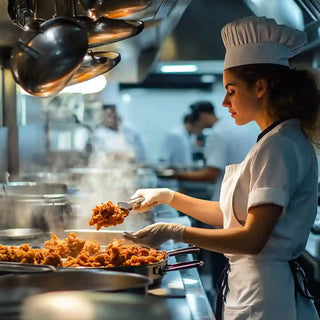
In a traditional fried chicken kitchen, frying equipment was engineered for the 1990s family-bucket dining model. Line cooks drop massive 6-head or 8-head batches of bone-in chicken or oversized full baskets of wings into high-capacity vats, then transfer the cooked product into heated holding cabinets.
Traffic distribution data across 221,000 QSR outlets reveals a sharp 12:00 PM lunch peak and 6:00 PM dinner peak, separated by a deep mid-afternoon valley (2:00 PM–5:00 PM) and a fragmented late-night tail (9:00 PM–12:00 AM). When a restaurant operates near the $560–$950/day breakeven line, legacy mass-batch frying creates two fatal leaks in the 65% Prime Cost ceiling:
-
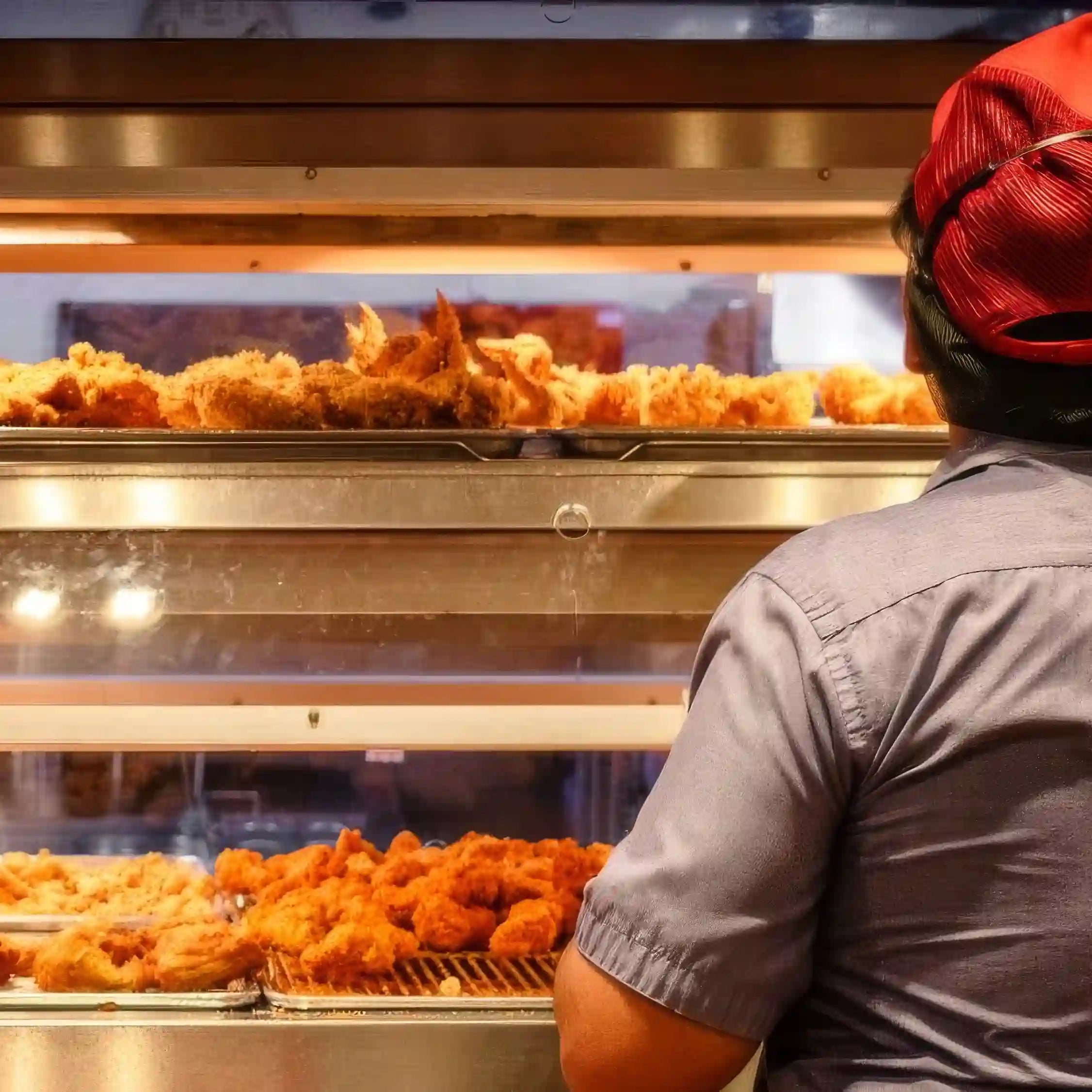
Off-Peak Hold-Time Shrinkage: Fried poultry held beyond 45 to 60 minutes suffers moisture loss and breading degradation. Kitchens cooking in large batches during slow hours end up discarding 12 to 15 lbs of expired wings, tenders, and bone-in pieces daily—wiping out 35% to 50% of a lean store's daily net profit.
-
Thermal Crash & Oil Degradation: Dropping heavy, oversized baskets into standard fryers triggers a steep oil temperature drop, extending cook times, increasing grease absorption, and accelerating free fatty acid breakdown in expensive cooking oil.
To eliminate this waste, modern enterprise QSR kitchens have rewritten their Standard Operating Procedures (SOPs): stop cooking for the holding cabinet, and engineer the hardware for continuous, on-demand Micro-Batch Frying.
2. Open-Vat Micro-Batching: Custom Quad Mini-Baskets & Integrated Chassis Side-Hanging Rails
Look closely at a modernized franchise fry station—exemplified by the Tenshine TFS-EF142C 28 kW Heavy-Duty Commercial Double Electric Floor Fryer—and you will spot a distinct structural departure from conventional Western floor fryers.
Instead of equipping two 6.6-gallon (25L) vats with two wide, heavy baskets, enterprise QSR specifications utilize four customized narrow micro-baskets (two independent mini-baskets per vat) paired with heavy-duty side-hanging oil drainage rails welded directly into the left and right edges of the fryer chassis:
-
High-Frequency Segmented Drops: Controlled by a proprietary 32-bit industrial microcomputer board (featuring 12 programmable menu keys per tank and 3 automated shake-basket alerts: SH-1, SH-2, SH-3), a single operator can simultaneously fry a 4-piece wing order in Micro-Basket 1, a solo portion of French fries in Micro-Basket 2, and chicken tenders in Micro-Basket 3—each governed by an independent countdown timer with zero over-production. Because the 32-bit architecture is engineered in-house, lifetime board replacement costs are a fraction of legacy Western brands.
-
Lateral Side-Rail Oil Recovery (Slashing Shortening Costs by 30%+): In standard cooklines, lifting a wide basket from the rear hanger and swinging it across to an adjacent dump station drips hot shortening across equipment seams and kitchen floors. With Integrated Heavy-Duty Side Rails, line cooks lift a lightweight micro-basket and hook it laterally onto the side rail directly above the bevelled vat rim. Excess surface oil drains 100% back into the 25L tank during the initial 30-second crisping phase—preserving expensive shortening and eliminating the need for an extra dump table under costly exhaust hood space.
-
28 kW Dual-Core Freeze-Down Recovery & 15-Minute Built-In Filtration: Frequent micro-batching requires instantaneous heat recovery. Dual 14 kW swing-up immersion elements (28 kW total power) prevent thermal lag during peak rushes and swing up 90 degrees for unobstructed vat scrubbing at close. Meanwhile, the self-contained bottom filtration cart and dedicated oil pump filter 50L of hot shortening (at 176°F–302°F / 80°C–150°C) in under 15 minutes via simple blue-drain and red-return valves, completely eliminating manual hot-oil handling hazards.
3. The Thermodynamic Breakthrough: Active Pressure-Compensation (APC) for Single-Bird Pressure Frying
While open fryers handle wings, nuggets, and fries, the signature anchor of any poultry chain is Southern-style pressure-fried bone-in chicken.
For more than half a century, commercial pressure fryers have been bound by a strict physical limitation: passive steam pressurization.
Conventional pressure fryers rely entirely on the natural water content inside raw chicken to vaporize upon hitting hot oil, building chamber pressure to the required 12–14 PSI. If a kitchen drops fewer than 2 whole chickens (8 to 16 pieces) into a standard pressure fryer, the smaller meat volume fails to generate enough steam to pressurize the kettle. The result is under-pressurized cooking—yielding dry meat and soggy breading. Because of this thermodynamic bottleneck, restaurants have historically been forced to fry a minimum of 2 to 4 whole birds per batch, leading to massive protein waste during mid-afternoon and late-night hours.
To bring true micro-batching to bone-in poultry, Tenshine's R&D engineering team developed a proprietary Active Pressure-Compensation (APC) System for our commercial pressure fryer line:
-
True Single-Bird Pressurization: Rather than relying solely on meat moisture evaporation, our Active Pressure-Compensation architecture dynamically supplements and stabilizes internal kettle PSI. This allows cooks to pressure-fry just 1 single whole chicken (or a small 4-piece bone-in order) at full operating pressure with zero loss in moisture retention or crust crispness.
-
Unlocking All-Day Bone-In Profitability: With APC technology, QSRs and convenience store delis can cook bone-in pressure-fried chicken strictly on demand during slow off-peak hours (2:00 PM–5:00 PM and after 9:00 PM). Unsold hold-time waste is virtually eliminated, keeping Food + Labor Prime Costs safely below the 65% threshold.

4. Actionable Takeaways for North American & Global Restaurant Operators
In the United States and Europe, independent restaurant owners and regional franchises are facing the exact same squeeze that legacy international chains faced in Asia: soaring equipment prices from traditional middlemen, 15%+ rent pressures, and high off-peak food waste. The 2026 survival playbook is clear:
-
Slash Equipment Depreciation with Factory-Direct Supply Chains: Just as global QSR giants in Asia replaced overpriced legacy imports with domestic OEM equipment to lower store breakeven lines, North American operators can cut Capex by 40%–50% by sourcing directly from specialized manufacturing engineers with Free DDP Door-to-Door Freight.
-
Right-Size Your Batch Drops to Protect Your 65% Prime Cost: Replace oversized batch baskets with quad micro-basket configurations and Single-Bird Active Pressure-Compensation (APC) fryers. Cooking smaller drops every 3 minutes beats discarding half a holding cabinet every 60 minutes.
-
Capture Every Drop of Shortening Under the Hood: Specify standardized 33.1" (840 mm) flush-banking fryers equipped with lateral side-hanging drainage rails and built-in pump filtration to cut annual oil expenditure by 30%+ while helping your store stay safely above the 1.2X breakeven buffer.
Explore Tenshine's Factory-Direct QSR Frying & Kitchen Architecture:
-
Micro-Batch Open Fryer: View the Tenshine TFS-EF142C 28 kW Commercial Double Electric Floor Fryer with Built-In Filtration & Side Rails
-
Auto-Lift Pressure Frying: Explore the Tenshine TS-EP-H1800 Commercial Auto-Lift Electric Pressure Fryer Series
-
Turnkey Chicken Prep & Holding: Pair your cookline with our Silent Electric Breading Table (BT-1E) and Floor-Standing Fry Dump & Warming Station (TS-FDS10)
-
B2B Engineering & Media Inquiries: Journalists, industry analysts, and multi-unit restaurant operators seeking technical specifications on our Active Pressure-Compensation (APC) Single-Bird Pressure Fryers or custom OEM/ODM franchise cooklines are invited to contact Tenshine Foodservice Solutions directly via our website or official LinkedIn page. All North American orders include 100% Free US DDP Door-to-Door Freight.